Introduction to Cooking
It was 11am on a Sunday in the summer of 2017, and I wanted eggs benedict. I had just wrapped my sophomore year at USC, and I was living alone near campus. No parents to cook for me. No dining hall. No roommates to steal from.
The craving for eggs benedict was deeply rooted in memories of The Original Pancake House in Torrance that I’d visit with my parents as a kid. But now, if I wanted poached eggs and crisp ham on an English muffin, smothered in Hollandaise, I’d have to figure it out for myself.
I’d never had any interest in cooking, or any need to do so. I liked eating, though, and I was hungry. I typed “Gordon Ramsay eggs benedict” into YouTube. Why Gordon Ramsay? Because I knew who he was, and I figured if anyone could instruct me on a proper eggs Benedict, it would be him.
I watched the video a few times, then went for it. At the last, crucial moment, when I went to taste the Hollandaise that crowns the Benedict, what I got was an oily, broken mess with bits of scrambled egg. This was not the Hollandaise I remembered from OHOP. I dumped the whole thing in the trash, and considered my next move.
What would you have done if you were me? Cut your losses and eat the eggs without Hollandaise? Abandon the whole debacle and go out for a late brunch? Be honest. It’s not as though eggs Benedict are hard to come by. There was a diner around the corner that could have scratched the itch for me. I only needed to concede defeat.
But I’m not one for shortcuts. Plus, I’d already dedicated my morning and part of the afternoon to this project. I’d invested the time, effort, and money into shopping for the ingredients. I’d poached eggs, crisped prosciutto, toasted muffins. To come all this way and not eat eggs Benedict the way they’re meant to be eaten—I couldn’t do it. So I started from scratch. I rewatched the video a couple more times, and noted how Ramsay slowly streamed the butter into a saucepan set over a double boiler. I had no idea what an emulsion was, or the mechanics of keeping one together, but this time around, I whisked the butter into the Hollandaise slowly, off the heat, and it worked. It took two tries and several hours of labor, but I’d made myself breakfast.
Later that week, I parlayed this small victory into another. I invited a friend over to try my now famous eggs Benedict. He didn’t eat pork, so technically I made him eggs Norwegian, with smoked salmon. I even took the time to put together a nice little chive garnish. It was the first time I’d ever cooked for someone else. He loved it, and I felt incredible.
This moment couldn’t have come at a better time. The prior semester, I’d dropped out of the pre-med program—a path I’d been on since high school. My parents had always wanted me to be a doctor, and I wanted to make them happy. This is going to sound like I’m talking to my therapist, but getting praise for something other than my academic achievement was huge for me. I have no problem admitting that feeding my ego is a huge reason why I continue to cook.
How we got there
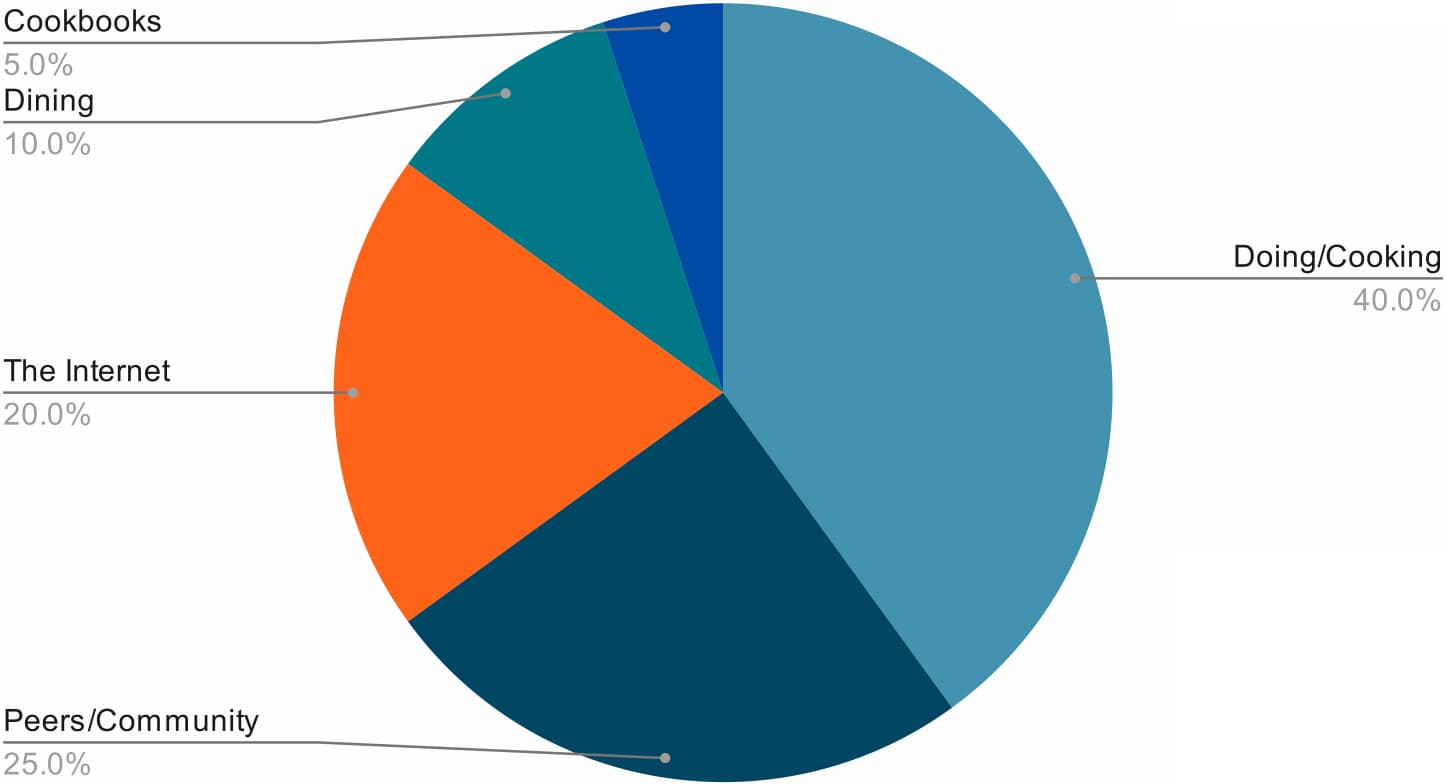
Doing/Cooking: Between cooking at home, staging at restaurants, starting a supperclub, I learned through repetition. The more you cook, the more you reinforce the connection between mind and body. Doing something once is never enough.
Peers/Community: I learned so much from my peers/colleagues at Maru Supperclub. Owen Han taught me a lot about Italian food; Ryan Hosey and I would test a lot of East Asian cuisine, and other friends would tell me random tidbits of knowledge. Conversations hold a lot of weight with me, because they spark ideas, and teach problem-solving.
The Internet: YouTube, ChefSteps, random food blogs, and the power of Google. Learning to refine your searches to a specific recipe or technique is key.
Dining: I was a broke boy and didn’t eat at many restaurants when I first started cooking, but I’d try to replicate whatever I ate. Kato, DAMA, Rossoblu, Jon & Vinny’s, AVRA, Son of a Gun were my early inspirations.
Cookbooks: I should probably say cookbooks played a bigger role in my early culinary education, but honestly I couldn’t afford very many. Still, The Nobu cookbook, NOPI by Ottolenghi, and a.o.c. by Suzanne Goin were indispensible.
After that first foray into eggs Benedict, I started cooking on the regular. I made breakfast every morning, and cooked dinner two or three times a week. ChefSteps became my bible for any recipe I wanted or any questions I had. The way they detail their recipes and explain the how’s and why’s of cooking appealed to my aborted attempt at studying pre-med. At the end of the year, I got a sous-vide water circulator, and began vacuum-sealing and circulating whatever I could get my hands on. If I look back now, it was all probably garbage, but I was pretty happy with the results at the time. Besides, I find that being pleased with yourself is essential to getting better…
...which explains why I quit making sous-vide short ribs.
I’d come across this recipe on ChefSteps for 72-hour sous-vide short ribs. They promised to be super melt-in-your-mouth tender and perfect, and blah blah blah. Sous-vide was very much in the zeitgeist, and I felt like I had a good hand on the process.
I procured a bunch of massive short ribs, invited some friends over for dinner, and set off on a three-day journey of slow-cooked meat. On the big night, I served the short ribs with pomme puree, and while my friends were nice about it, the prevailing sentiment was that my short ribs were not good. They were bland and mushy. They tasted like they’d been tortured for 72 hours, and I didn’t understand why. I didn’t know to sear the meat before putting it in the bag, or that I needed to season aggressively with such big pieces of meat. I only knew that I’d embarrassed myself. Screwing up Hollandaise was one thing, but I’d spent a lot of money on these short ribs. It was such a long project for such a letdown. I really never wanted to try again. I put the circulator way after that.
At some point in that first year of cooking, I watched an art-house documentary called Paladar, about two USC students who’d started a supper club in their college apartment. Neither had any formal training. They charged $15 for three courses, and were mostly flying blind. I was inspired. During the last year of college, I started hosting small dinners out of my apartment with a friend, Ryan Hosey. It was purely for fun—I only asked friends to pay for the cost of ingredients. It was a senior-year fling, but I found that I really loved putting on events, and I threw a few concerts, too, along with the dinner parties.
After graduating in the spring of 2019, I struggled to sort out what to do next. I decided to stage at Kato under Jon Yao for 2 weeks (June 2019). I learned a lot (to be explained later) but Yao opened my eyes to the world and operations of fine-dining restaurants. I traveled that summer to Korea, and I returned to LA and landed a job with celebrity wedding planner Kevin Lee. I was still cooking a lot, but I didn’t think about it as a career path.