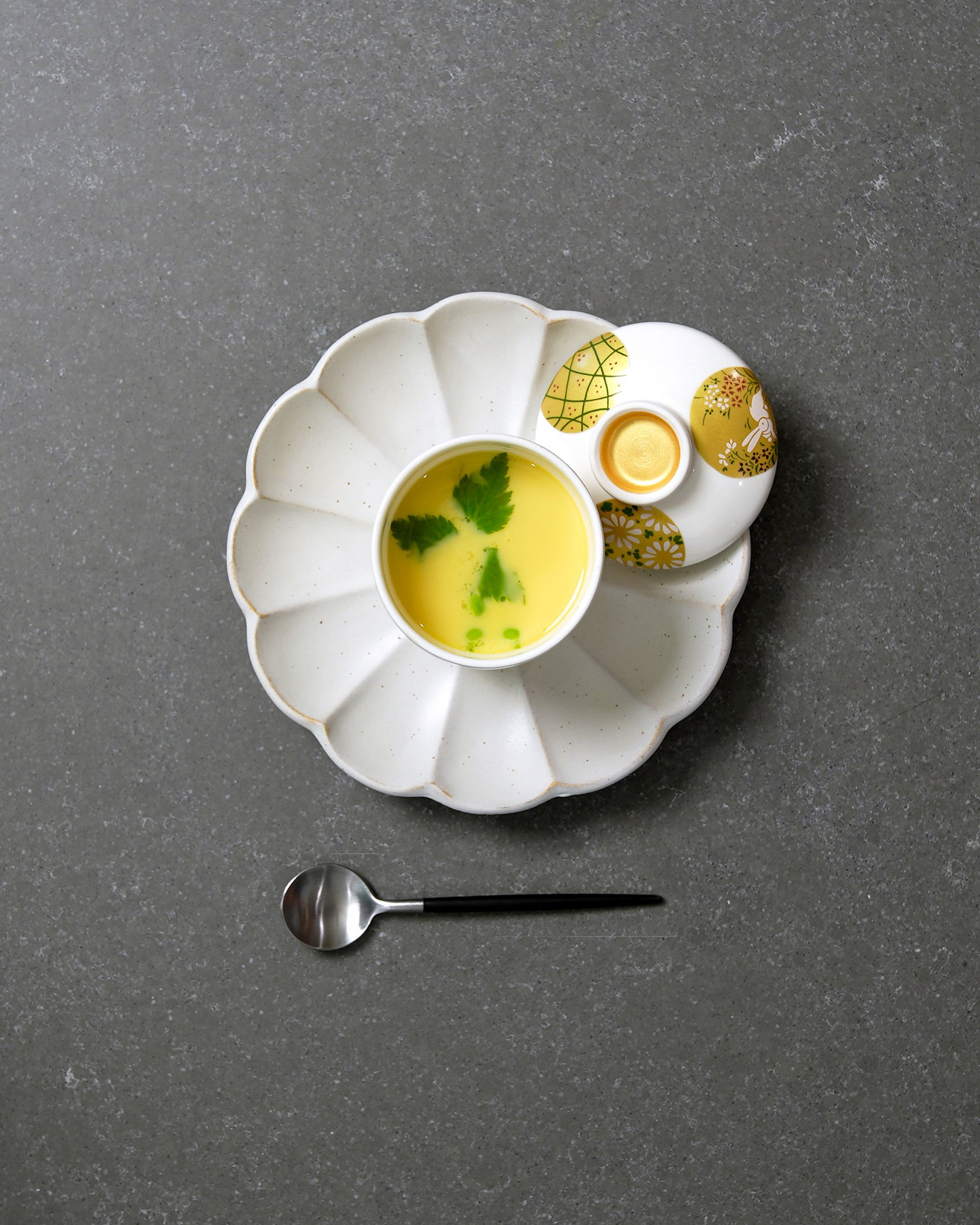
how to achieve the highly coveted chicken 'aspic'
10 comments

hwoo.lee
•
July 17, 2026
If you are new to my Hainan Chicken R&D Series, welcome, and please read through my Hainan Chicken V1 recipe for a backstory. Since the start, I have posted several other Hainan Chicken recipes, which you can see in the collection here.
To me, Hainanese Chicken has 3 distinct qualities I am looking for:
If you ask a chef what the most difficult aspect of Hainan Chicken is, 99% will probably say achieving the jelly (aspic) under the skin.
So... what is the jelly?
Based off the research that I've done, there isn't a definitive answer. Most sources say it's a natural meat aspic — a collagen and gelatin-rich jelly with some emulsified chicken fat, dissolved from the skin, joints, and bones into the cooking liquid, then set when chilled.
Some sources argue that it's mostly subcutaneous fat, noting that the jelly stays solid at typical hawker‑stall ambient temperatures, whereas gelatinous stock would begin to soften or melt at those temperatures.
So... why do you like the jelly?
I think it's a nice to have component for Hainan Chicken, but it isn't necessary. I believe the jelly adds to the 'slippery and supple texture' that is highly-sought after in Hainan Chicken. A slippery, tender, and gelatinous bite of chicken is what I'm after, and the type of skin can make up in suppleness for the lack of jelly.
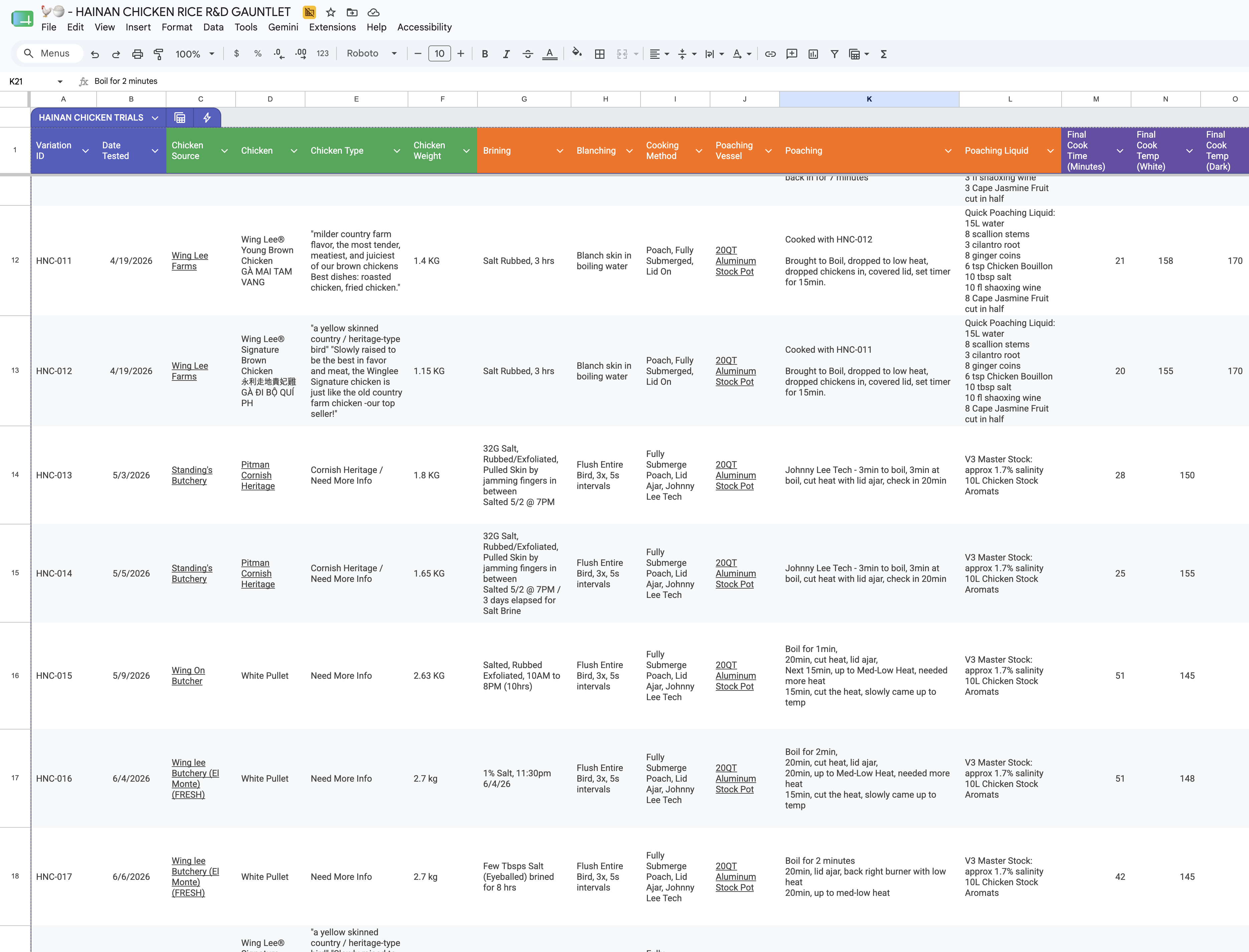
The purpose of this R&D series was to solve for a consistent method to cooking Hainan Chicken at home, while achieving the jelly under the skin. Over the last few months, I tested different methods, chickens, and times - you can see them all here.
My most recent 8 birds have all gotten jelly. I don't know exactly why, maybe it was consistency with my methods, maybe I was cooking them more "perfectly", or maybe it was the chicken gods blessing me. I will share below exactly every variable, technique, and ingredient I used so that you can replicate this at home.
The best way to think about chicken jelly is to compare it to the flowing juices of a perfectly cooked steak.
Imagine cooking a steak to a perfect medium rare on the grill. You place the steak on a cutting board and slice right into it without letting it rest. Within seconds, red-tinted myoglobin-rich juices flood the board—it’s all that meat juice. If you let the steak rest for a few minutes before slicing, you’ll notice that the muscle fibers relax and retain most of their juices.
Now imagine grilling a chicken thigh. If you slice right into it without letting it rest, there aren’t as many red meat juices (sometimes a little), but the exuded liquid is thicker, richer in fat, and noticeably more viscous.
Now, imagine an entire chicken, slowly poaching in a master stock—almost like sous vide—where the skin is the only enveloping layer that can retain the meat juices. Unlike a high heat grill, the gentle heat of the surrounding master stock slowly brings the chicken's internal temperature up without aggressively heating and expanding its muscles.
Once the chicken is cooked, it's shocked in an ice bath, and the skin tightens up like shrink wrap. Similar to how a steak wants to extrude its meat juices, a chicken will want to extrude its meat juices as well. If there are no tears in the skin, it'll be able to keep all the meat juices in while it cools. Eventually, it'll cool down enough that those meat juices will solidify into what we see as jelly (aspic).
I have only found jelly outside of the thigh, drumstick, oysters, and wings—never on the breast. I suspect that the meat juices are coming from joints, dark meat, and thicker skinned areas. I find the most impressive jelly particularly on the thigh cap (as seen in this video).
Lastly, I suspect that fresher chickens yield more jelly than older birds. Continuing the steak comparison: if you have ever cooked a dry-aged steak, you’ll notice there is much less of those red‑tinted, myoglobin‑rich juices. I believe a similar comparison can be made between freshly killed chickens and typical grocery store chickens.
When I buy chickens from an Asian poultry butcher, I know they were slaughtered that morning. The birds feel firmer, they don’t have any noticeable smell, and they simply taste more chicken‑y. In contrast, grocery store birds sit in a vacuum‑sealed bag of their own juices for who knows how long, and they almost always have an unpleasant odor. I suspect that the longer the chicken sits, the more it dries/loses its natural juices. In my trials, I have noticed jelly from grocery store birds, but not nearly as much as the high-quality Asian butcher birds.
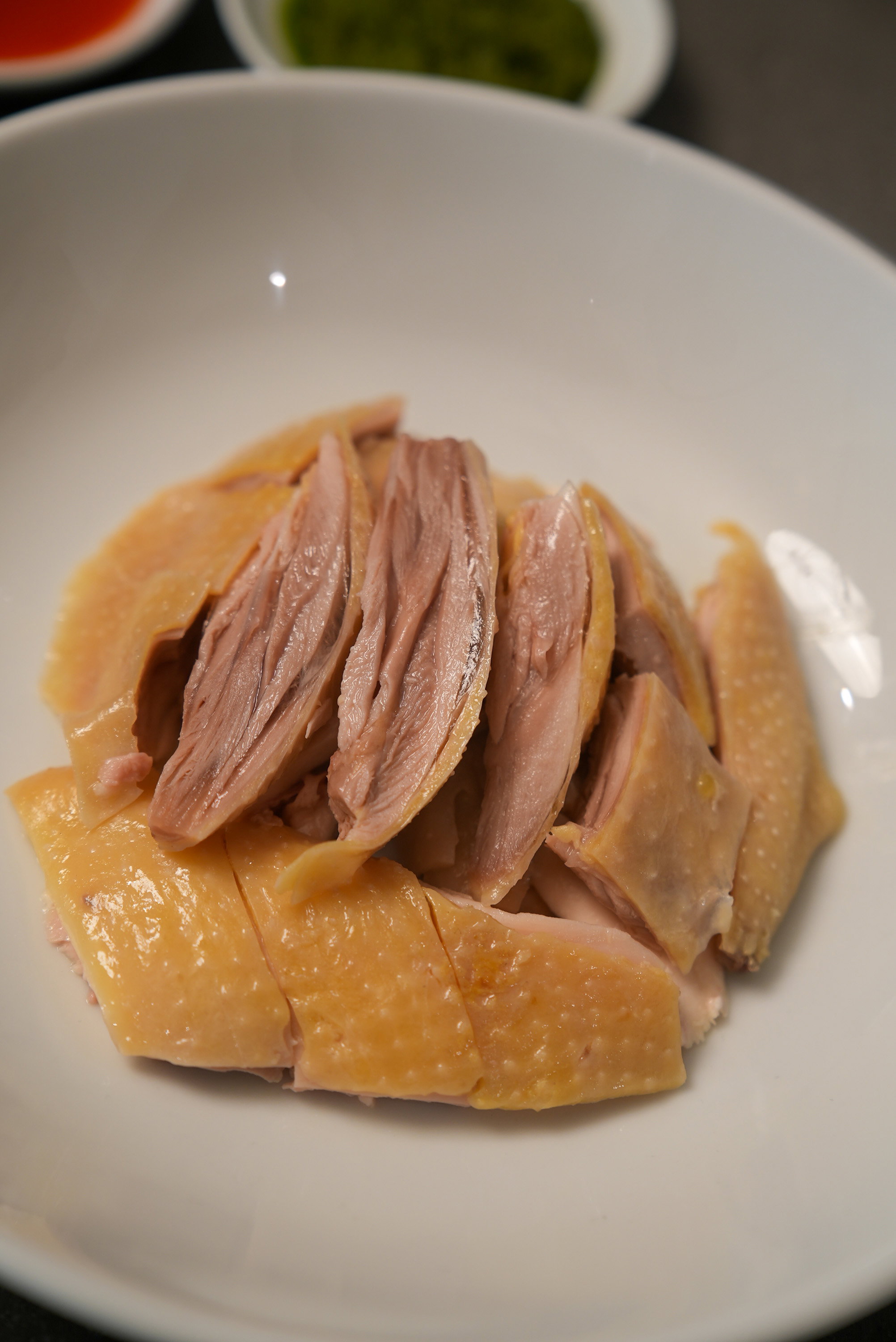
If you wanted a TLDR, this is it.
Certain chickens yielded more jelly than others, and certain methods yielded better than others. I don't know exactly why I am getting jelly, but I suspect it is these factors:
If you follow my instructions below and practice poaching Hainan Chicken, I am confident that you will be able to yield a nice chicken jelly.
Personally, I actually like my Hainan Chicken to be at room temperature. This method of getting jelly (aspic) requires a longer chilling process that will chill the meat as well.
If one were to heat the chicken back up, you may accidentally melt the jelly (aspic) away. However, if you were able to hold the chicken meat side up, ladle some hot chicken stock, and then cut the chicken, you could have both room temp meat and jelly.
If I had it my way, I would use Kampung Chickens from SE Asia for this dish.
I live in Los Angeles, so the chickens that are available to me may differ from what you are able to get. These are the places I recommend:
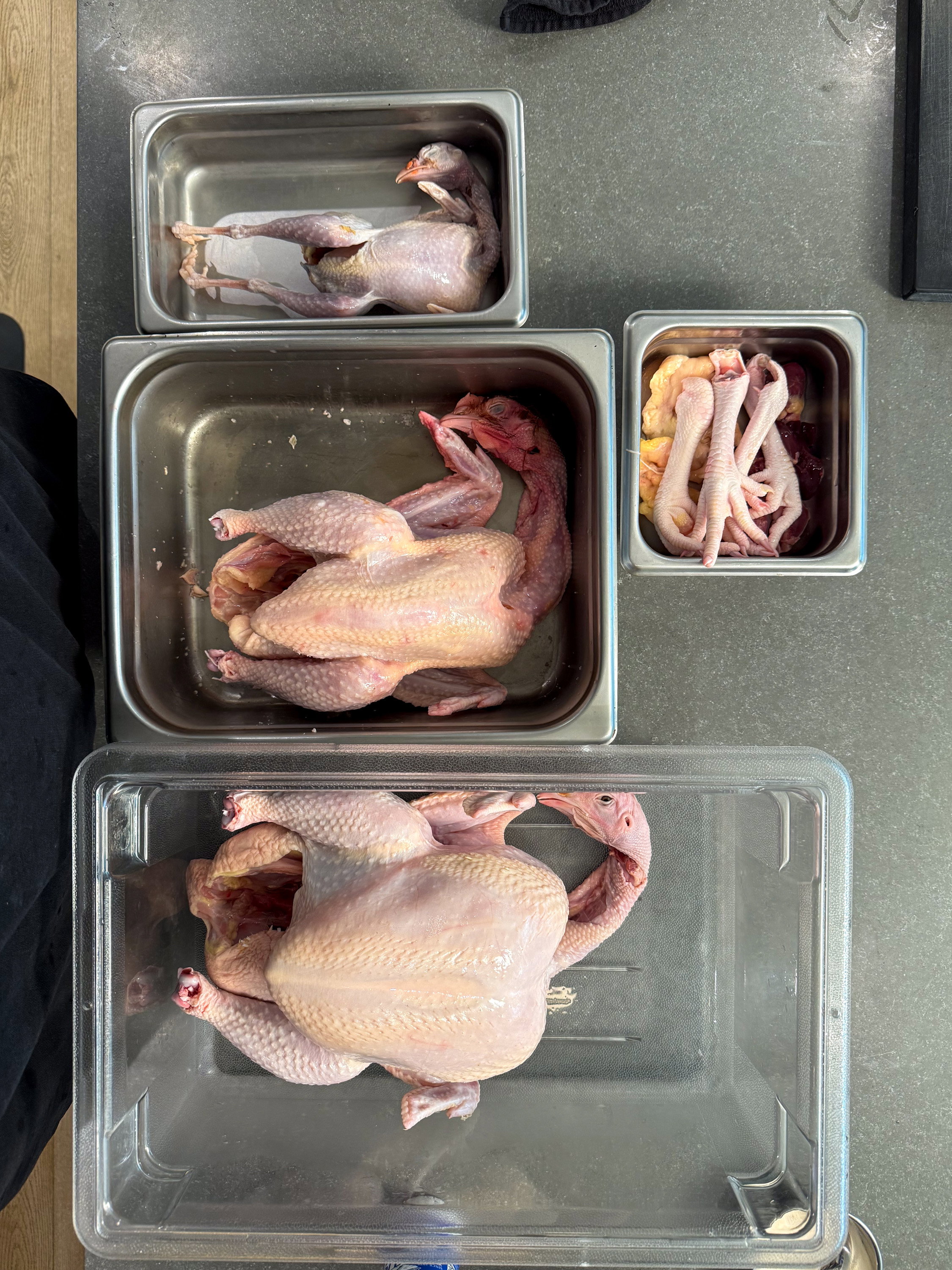
Top to Bottom: Chukar, Young Brown Chicken, White Pullet Chicken
Once you arrive at any of these butchers, you'll notice a few chicken options.
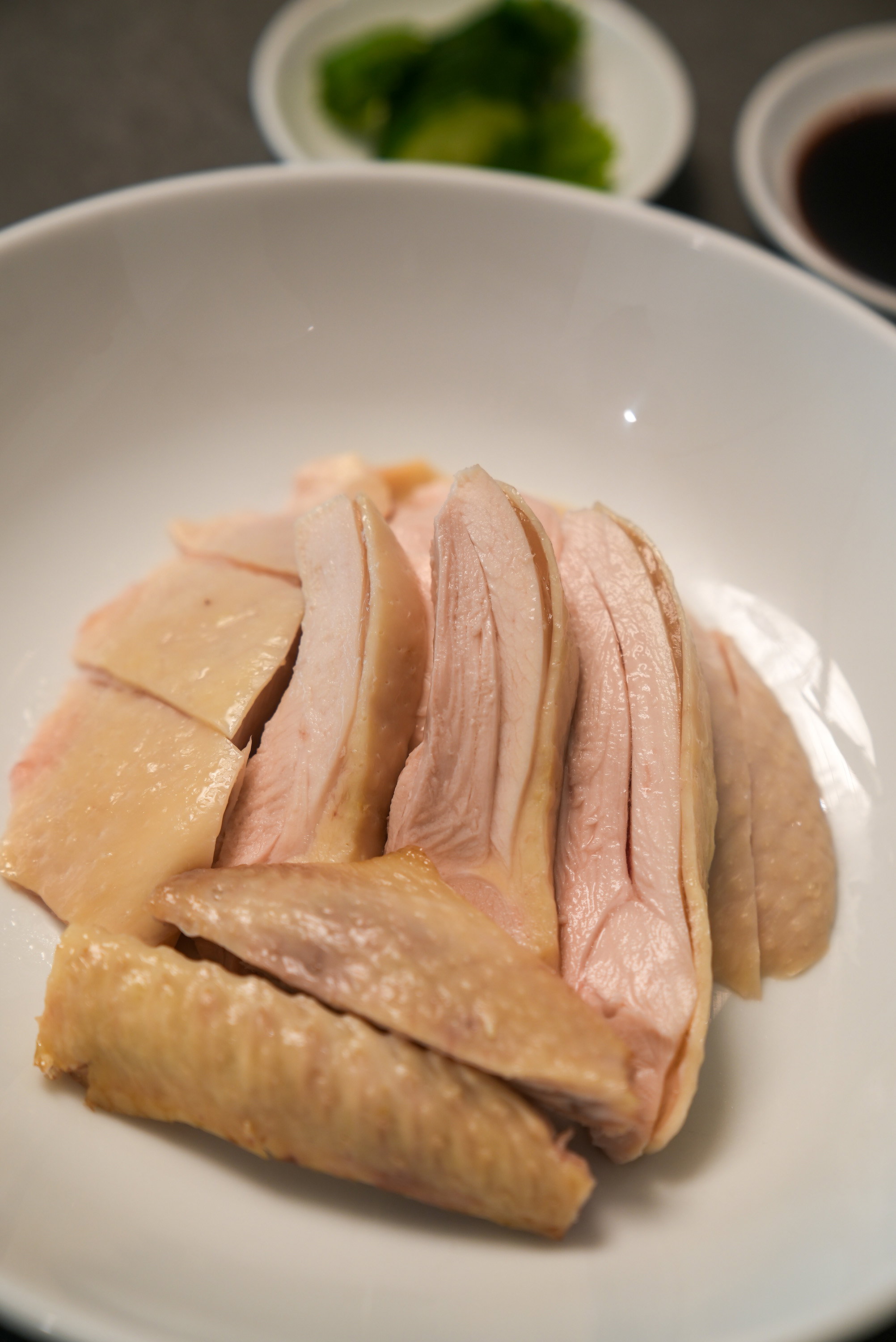
If you prefer a larger chicken, more tender meat, but less chicken flavor - go with the White Pullet.
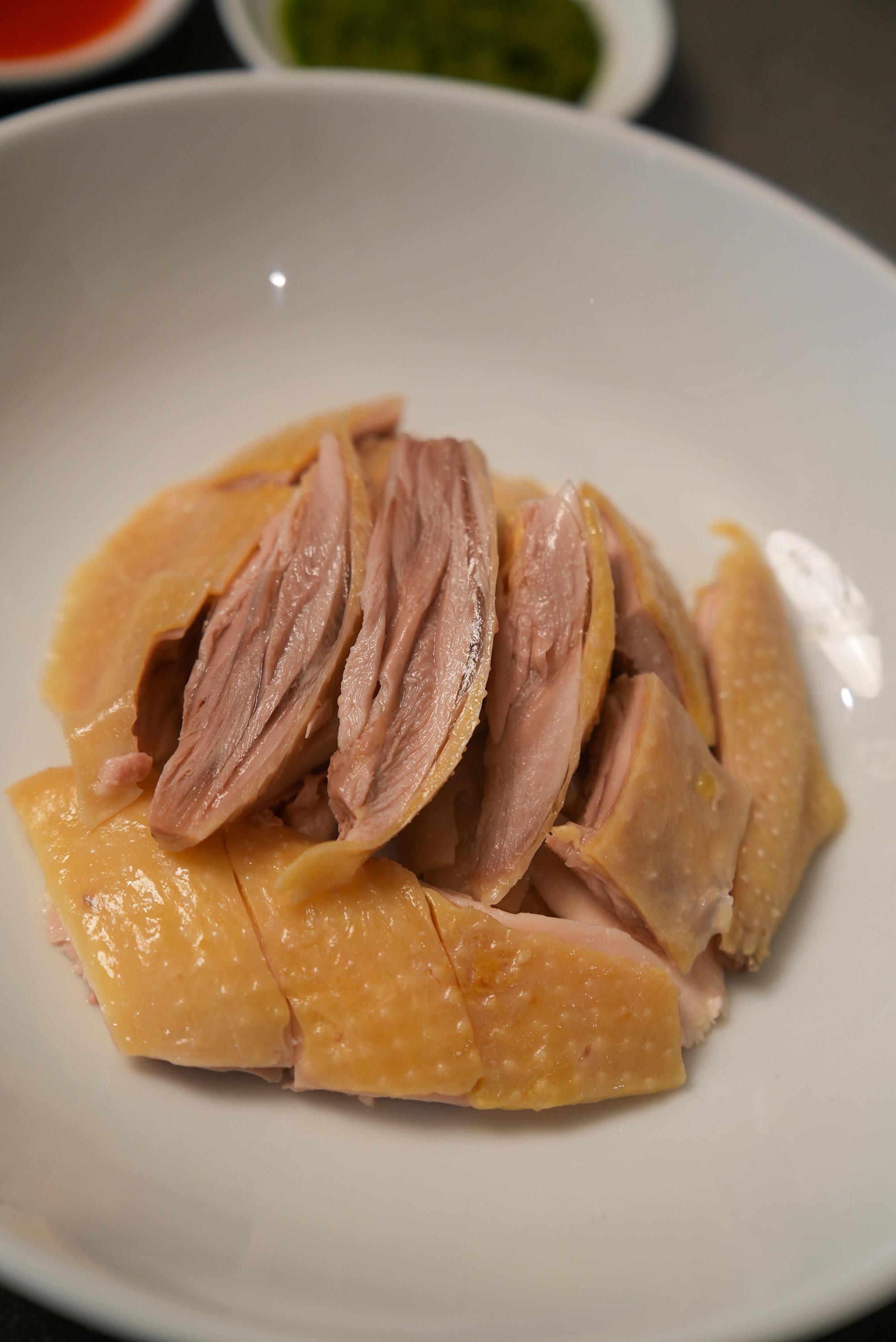
If you prefer a thicker skin with a more chicken-y/gamier bite - go with the Young Brown Chickens.
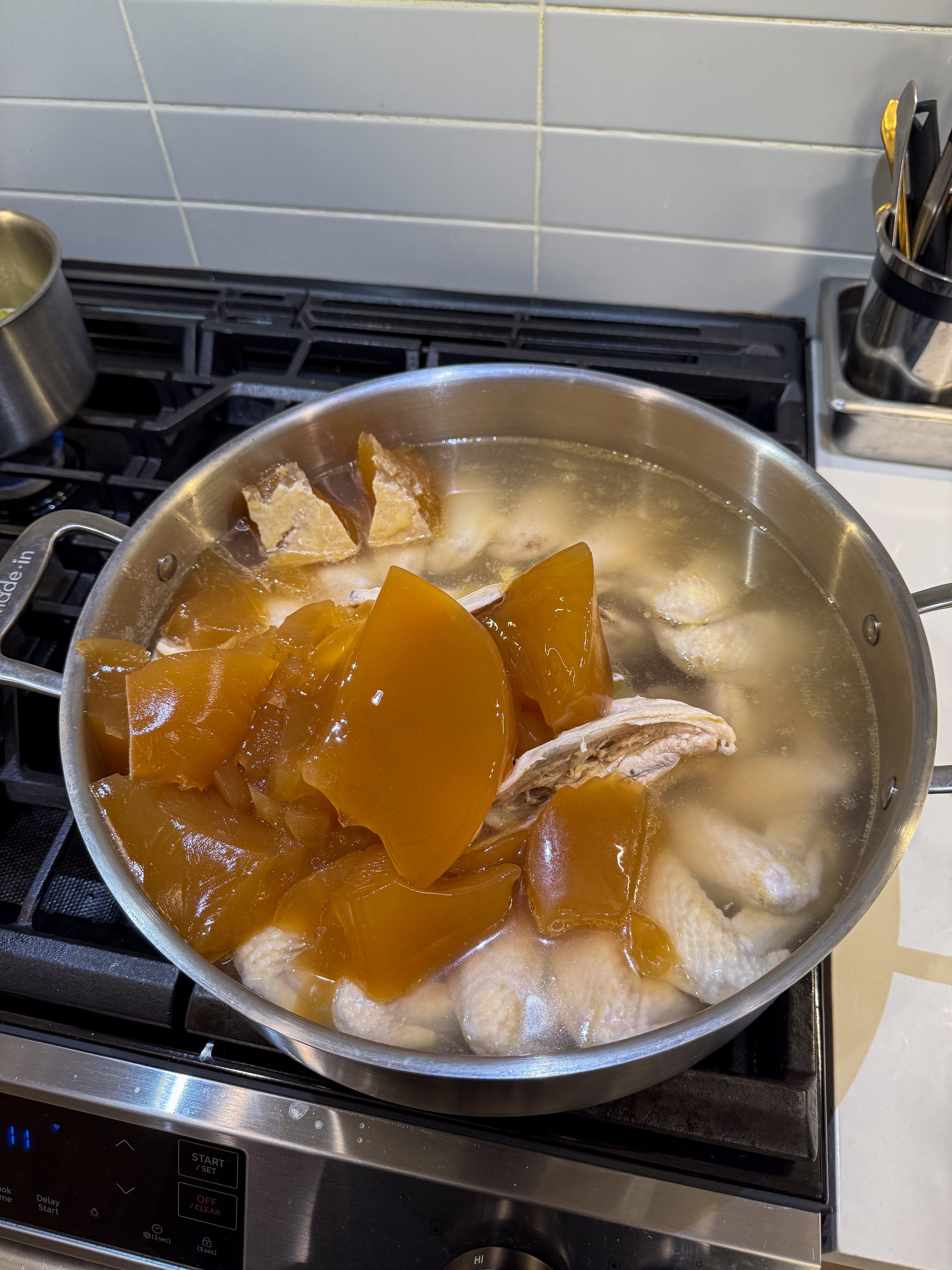
I would read my description of this Hainan Chicken 'Master' Stock here first.
Since I began my 'Master' Stock, I've added every single carcass that I've cooked, a few more kilos of chicken feet, and some aromatics along the way. It is perpetually getting more chicken bones.
However, I do believe that at some point, a stock can "max" out. Maybe adding more just psychologically makes it better for my Hainan Chicken poaching? I don't fully know. I'll keep the stock going until I either move out of the country, or die.
Keep in mind, I keep my 'Master' Stock at around 2% salinity.
I 'birthed' this Hainan Chicken 'Master' Stock in Dec. 2025. Over the course of 7 months, I have simmered and extracted the flavor, collagen, etc. of: chickens (50 whole), feet (5 kg), wings (5 kg), and carcasses. With the addition of new bones, I allow to simmer for a good 4 to 8 hrs, then I remove those bones and add them to a Secondary Stock.
this stock can essentially live forever. I allow it no more than a week in my fridge before I place it in my freezer.
Before every time I poach a new Hainan Chicken, I will add a handful of fresh aromatics, usually just ginger and scallions. If I want a yellow color, add a tsp of turmeric or a few dried cape jasmine fruits.
Make sure to replenish with enough fresh water to keep the salinity at around 2%.
If you have a Buddhist-Style Chicken (meaning with head and feet), remove the feet and reserve for the stock. Remove the tail and fat inside the cavity for later use.
Exfoliate the chicken with about 4 tbsp of salt. Rub it into the skin thoroughly, removing any excess debris, and then allow the chicken to cure overnight.
When handling the chicken, it is best to hook it underneath it's armpit, near the back spine and pull towards the neck, at a 45 degree angle.
Cut the small slit in the skin above the wish bone and below the neck to allow for air to escape when you flush the bird
Bring the 'Master' Stock to a boil, hook the bird with a hook, and drop into the boiling master stock for 5 seconds, making sure the stock flushing the entire interior cavity of the bird. Lift bird back up for 2 seconds to empty the cavity.
Subscribe to get my new recipes delivered to your inbox
Sign in to comment